Risk Management and Emergency Response | Governance and Integrity | Taiwan Blood Services Foundation ESG

Governance and Integrity


Risk Management and Emergency Response
Risk Management
To reinforce organizational operational resilience, the Foundation identifies and evaluates internal and external risks, examines environmental dynamics, and assesses both internal and external impacts to ensure the sustainable legacy of voluntary blood donation. Annually, the Chief Executive Officer presides over the "SWOT Strategic Planning Meeting" to evaluate operating environments across Strengths, Weaknesses, Opportunities, and Threats (SWOT). Future strategic directions are formulated to address environmental shifts and mitigate potential risk impacts. Annual work plans are devised according to the SWOT risk assessment matrix, with corresponding progress reports compiled to track implementation. Furthermore, headquarters and regional blood centers convene semi-annual Management Review Meetings to audit risk mitigation measures and proactively prevent operational hazards.
Emergency Response
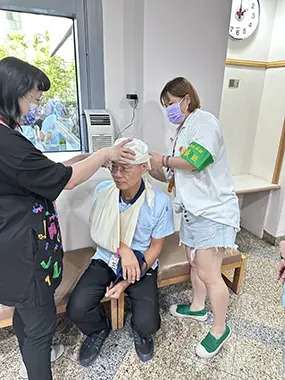
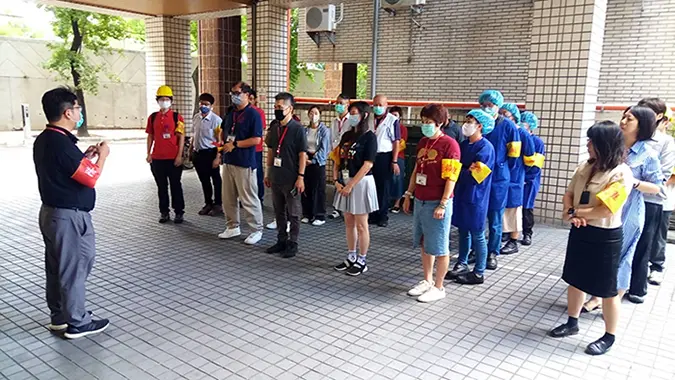
The Foundation has established the "Emergency Response Operating Procedures" to govern crisis management protocols for diverse contingencies, including fires, windstorms, earthquakes, epidemics, and information security incidents. An Emergency Response Task Force has been instituted, convened by the CEO or directors of regional blood centers. Response workflows address pre-disaster preparedness, on-site incident control, post-disaster recovery, epidemic containment, core IT system outages, and donor adverse event handling, ensuring the safety of donors and staff while sustaining blood collection and supply continuity. In 2023, to address traumatic hemorrhage during mass-casualty incidents, the Foundation formulated the "Contingency Operating Procedures for Blood Collection and Supply during Major Disasters" to secure clinical blood availability. Additionally, headquarters and all centers conduct annual hands-on fire and public safety drills.
Medical Pillar and Support
To deliver high-quality blood components, the Foundation continuously monitors international epidemiological alerts, travel health notices, and advisory levels issued by the Taiwan Centers for Disease Control (Taiwan CDC), promptly updating infection-risk zones to safeguard blood safety directly at the source.
In response to sporadic domestic outbreaks and transmission risks of Mpox, stringent donor deferral and management criteria were established on May 29, 2023, meticulously upholding blood transfusion safety.
Grasping Clinical Blood Demand, Elevating Transfusion Quality
To maintain blood supply-demand equilibrium, an annual "Blood Collection and Supply Coordination Meeting" is convened to determine donation target volumes for the upcoming year. To accurately anticipate clinical demand and reinforce communication with hospitals, regional blood centers conduct unscheduled hospital visits and hold at least one annual "Blood Supply Symposium" with healthcare facilities. Blood utilization trends are periodically analyzed to coordinate distribution dynamically, optimize inventory control, and secure safe buffer stock levels.
To enhance transfusion safety and minimize adverse reactions, the Foundation transitioned to a 100% supply of pre-storage leukoreduced red blood cells in 2022. Simultaneously, to advance precision transfusion services, red blood cell phenotyping and labeling were expanded for clinically critical antigens—including C, c, E, e, Jka, Jkb, Mia, and M—alleviating hospital crossmatch burdens and preventing hemolytic transfusion reactions.
1. Balancing Blood Supply and Demand
To achieve blood supply-demand equilibrium, the Foundation regularly convenes the annual "Blood Collection and Supply Coordination Meeting" to analyze supply-demand dynamics and formulate donation target volumes for the following year.
2. Grasping Clinical Blood Demand
To accurately capture clinical blood requirements, blood centers conduct regular and unscheduled hospital visits and host at least one annual "Blood Supply Symposium." By analyzing consumption trends, centers dynamically coordinate blood distribution to maximize blood resource efficiency while maintaining optimal safety stock levels.
3. Elevating Transfusion Quality and Safety
To elevate transfusion safety and reduce adverse reactions, the Foundation fully transitioned to supplying pre-storage leukoreduced red blood cell concentrates in 2022. To advance precision transfusion for chronically transfused patients, continuous RBC antigen screening is conducted for E, e, C, c, M, Mia, Jka, and Jkb antigens, delivering antigen-matched units and minimizing the incidence of clinical hemolytic transfusion reactions.
Climate Change Mitigation and Initiatives
Solar Photovoltaic System Installations
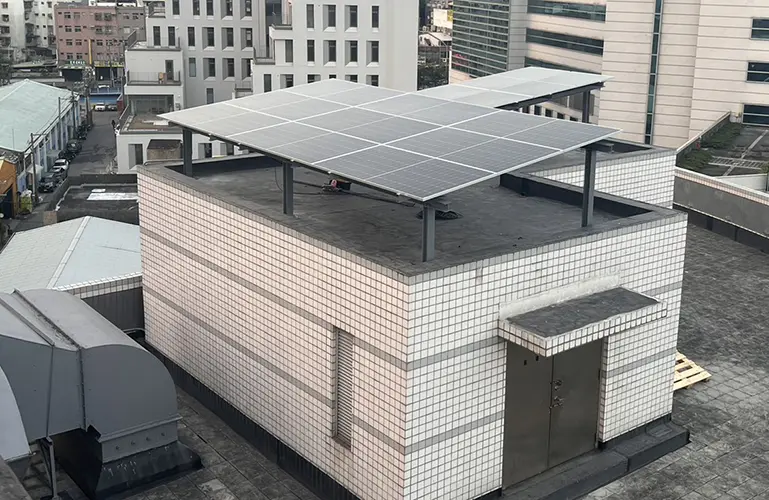
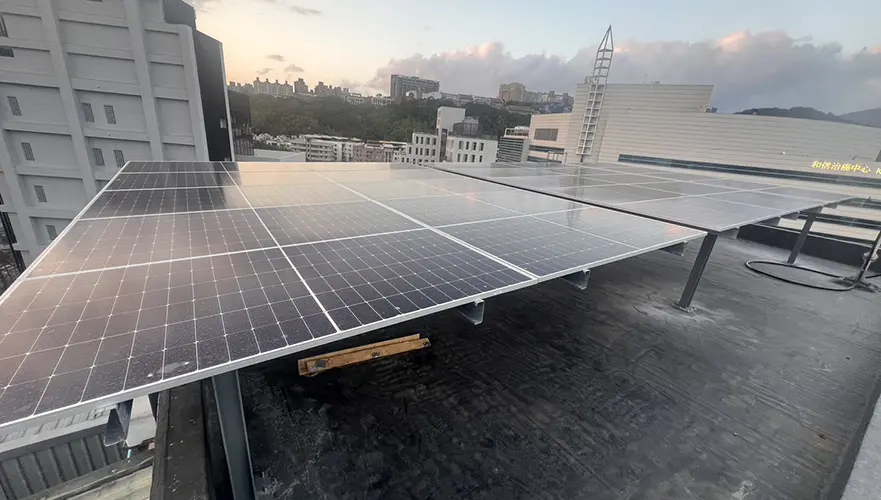
Since 2019, the Kaohsiung Blood Center has progressively installed solar photovoltaic (PV) systems across multiple facilities: 22.2 kW at Taitung Blood Station, 17.7 kW at Pingtung Blood Station, 62.7 kW at the Kaohsiung Blood Center Love Building, and 72.6 kW at the Tainan Station Love Building—totaling an installed capacity of 175.2 kW. These systems generate approximately 223,818 kWh of clean electricity annually (175.2 kW * 3.5 kWh/kW/day * 365 days = 223,818 kWh), achieving carbon emission reductions of 110,790 kg CO₂e in 2024 and 110,566 kg CO₂e in 2025.
On February 16, 2022, the Hsinchu Blood Center initiated on-site solar power generation for self-consumption to decrease reliance on Taiwan Power Company. Starting with solar-powered lighting at the 1st-floor loading dock of the Love Building, installations expanded across outdoor parking facilities. As of December 31, 2025, a total of 14 outdoor solar panel units (13 lighting units and 1 warning light unit) have been deployed at the Hsinchu Love Building: (1) 5 units at the bloodmobile canopy, (2) 1 unit at the car parking lot, (3) 2 units at the motorcycle parking lot, (4) 1 unit at the basement ramp entrance, (5) 2 units at the 1st-floor loading dock, (6) 1 warning light unit at the main street entrance, and (7) 2 solar panel units powering corridor lighting for the Supply Section.
On February 18, 2025, the Taipei Blood Center completed a rooftop solar PV installation on its Love Building. The generated solar energy feeds directly into the rooftop central air-conditioning distribution panel and air compressor electrical panels for self-consumption. As of December 31, 2025, cumulative power generation reached 26,328 kWh, resulting in an aggregate carbon reduction of 12,479.5 kg CO₂e.
Eco-Friendly Bloodmobiles: Curbing Carbon Emissions
Across Taiwan, approximately 1.8 million blood donations are collected annually, with over 50% relying on diesel bloodmobiles deployed into communities. Because mobile collection requires running diesel engines during transit and throughout donation sessions to supply power, continuous exhaust emissions impact local air quality. To align with green energy and decarbonization trends, the Foundation has established plans to progressively replace existing medium and heavy-duty diesel bloodmobiles with all-electric models. This initiative curtails tailpipe emissions, safeguards public health, preserves environmental quality, and boosts energy efficiency.
Following the donation of Taiwan's first electric bloodmobile, the "Fubon," by Fubon Financial Holding to the Taipei Blood Center in 2021, the fleet has expanded steadily. By 2025, the Foundation had received donations totaling 8 electric bloodmobiles. In 2025, these vehicles logged 35,953 kilometers, consumed 93,096 kWh of electricity, and produced 47,385.9 kg CO₂e. Compared to diesel bloodmobiles covering equivalent mileage, the all-electric fleet reduced carbon emissions by 38,232.6 kg CO₂e in 2025.
Additionally, the Foundation operates 7 dual-power hybrid bloodmobiles equipped with dual-energy systems. These vehicles navigate to collection sites using diesel power and subsequently connect to external shore power on-site to run air conditioning and donation equipment. By eliminating on-site idling emissions, donation operations become markedly greener. In 2025, these dual-power vehicles conducted 1,251 mobile operations, consumed 44,055 liters of fuel and 6,960 kWh of electricity, and generated 120,112.1 kg CO₂e. Compared to conventional diesel bloodmobiles across identical deployment frequencies, the dual-power units achieved an emission reduction of 32,154.7 kg CO₂e in 2025.
Mitigating Transportation Risks and Fostering Sustainable Supply Chains
Global logistics risks triggered by natural disasters and geopolitical disruptions have underscored the urgency of localized medical consumable manufacturing. Procuring domestic medical supplies mitigates freight risks while curbing transport-related carbon emissions. From initiating a pilot procurement of 100,000 domestically produced leukoreduction filter sets in 2019 to fully adopting domestic leukoreduction filters today, the Foundation procured approximately 2.17 million sets between 2019 and 2025. This localized sourcing eliminated an estimated 145 marine cargo containers, delivering carbon reduction benefits of approximately 113,600 metric tons of CO₂e—averaging an annual reduction of approximately 16,229 metric tons of CO₂e—continually dampening international shipping vulnerabilities while reinforcing healthcare supply chain resilience.
To further advance localized procurement and strengthen national blood security resilience, the Foundation has supported government initiatives to establish domestic blood bag manufacturing facilities. Since 2023, the Foundation has organized blood center technical site visits and collaborative discussions on blood bag engineering specifications. The domestic blood bag manufacturer secured Taiwan Ministry of Health and Welfare (MOHW) medical device licenses for its Whole Blood In-line Leukoreduction Filter Systems and Blood Bag Systems in October and November 2025, respectively, with clinical applicability evaluations scheduled to commence in 2026.