About us | Sustainability | Taiwan Blood Services Foundation ESG

Sustainability


About Us
Taiwan Blood Services Foundation
Before 1974, nearly all blood for medical use in Taiwan came from donations by patients’ relatives and from paid blood sellers. Paid blood donation was not only contrary to civilized values and damaging to national dignity, but also carried the risk of transmitting infectious diseases. As a result, public-spirited government agencies, civic groups, schools, companies, factories, and others jointly launched a campaign encouraging caring individuals to donate blood, in order to promote public-minded concern for society and help patients in need of blood. Under the advocacy of Mr. Pei-Huo Tsai, then President of the Taiwan Provincial Branch of the Red Cross Society, the Blood Donation Association of the Republic of China was established on April 19, 1974. From that point onward, Taiwan gradually entered the era of voluntary non-remunerated blood donation. To meet medical needs in different regions, the Association successively established blood centers in Taipei, Taichung, Kaohsiung, and Tainan beginning in August 1974, actively carrying out blood donation and supply operations across Taiwan.
To align with national policy and further improve the medical environment, after the implementation of the Medical Care Act, blood donation services were classified as a medical care institution, with the Department of Health, Executive Yuan—now the Ministry of Health and Welfare—as the competent authority. Therefore, the Chinese Blood Donation Association funded the establishment of the Blood Donation Foundation of the Republic of China, which was officially founded on January 1, 1990. On the same day, the Taipei, Taichung, Tainan, and Kaohsiung blood centers originally under the Blood Donation Association were transferred to the Foundation. After 1991, the Hsinchu and Hualien Blood Centers were also established. The Foundation was later renamed the Chinese Blood Services Foundation on July 1, 1992, and renamed again as the Taiwan Blood Services Foundation on October 18, 2004. In July 2007, the Department of Health, Executive Yuan, announced the “Naming Principles for Medical Care Foundations and Their Established Medical Institutions or Other Affiliated Institutions.” In accordance with the regulations, the Foundation was again renamed the Medical Foundation Taiwan Blood Services Foundation, which officially took effect on April 28, 2008.
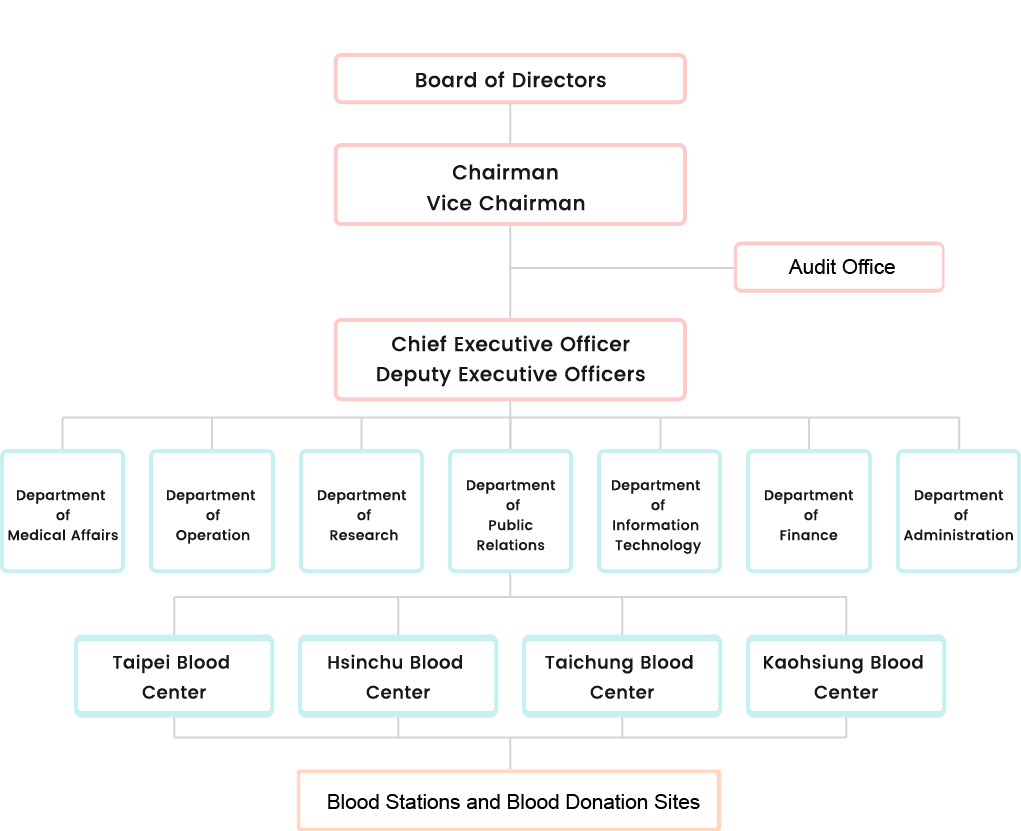
To improve the efficiency of blood donation and supply operations, the Foundation gradually carried out organizational streamlining and restructuring. On April 1, 2017, the Hualien Blood Center was reorganized as the Hualien Blood Donation Station. The Yilan Blood Donation Station and Hualien Blood Donation Station, originally under the Hualien Blood Center, were reassigned to the Taipei Blood Center, while the Taitung Blood Donation Station was reassigned to the Kaohsiung Blood Center. On January 1, 2020, the Yunlin Blood Donation Station was reassigned to the Taichung Blood Center. On January 1, 2023, the Tainan Blood Center was reorganized as the Tainan Blood Donation Station, and together with the Chiayi Blood Donation Station, was reassigned to the Kaohsiung Blood Center.
For more than 40 years, under the leadership of the government, the enthusiastic participation of the public, and the efforts of all Foundation staff, Taiwan’s blood services have successfully promoted the voluntary non-remunerated blood donation movement. In 1991, Taiwan’s national blood donation rate surpassed 5% for the first time, an internationally recognized threshold for achieving self-sufficiency, placing Taiwan among advanced countries in blood donation services. After many years of effort, Taiwan’s national blood donation rate has remained between 7% and 8%, ranking among the highest in the world and far ahead of the 4% to 5% levels seen in many other countries. This achievement has also earned international recognition. As the future environment changes rapidly and society may face threats such as global warming, climate change, and various natural and man-made disasters, Taiwan must prepare for future developments, reduce the risk of imbalance between blood supply and demand, and ensure uninterrupted blood supply and secure access to blood for medical use. To save the precious lives of patients, we must not only do more, but do better—continuously improving both the quality and quantity of blood, and sustainably carrying forward the spirit of voluntary non-remunerated blood donation embodied in the words: “I do not know you, but I thank you.”
At present, in order to effectively carry out blood donation and supply operations, the Foundation and its four blood centers have established 14 blood donation stations, 36 blood donation rooms, 15 fixed blood donation sites, and 136 mobile blood donation sites in townships and municipalities across Taiwan. These facilities provide convenient blood donation channels for donors and supply more than 99% of the blood used for medical care nationwide.