
Latest News
2025.07.21
News | Taiwan Blood Services Foundation ESG
- News
- Latest News
- Carter BloodCare Director Clinton McCoy Visits Taiwan to Exchange Insights on Blood Donor Recruitment Strategies
Back to List
Carter BloodCare Director Clinton McCoy Visits Taiwan to Exchange Insights on Blood Donor Recruitment Strategies
Latest News
2026.07.14
Clinton McCoy, Director of Mobile Donor Recruitment and Regional Operations at Carter BloodCare in the United States, recently visited Taiwan to attend the 2026 Rotary International Convention. During his visit, he took the time to visit the Taiwan Blood Services Foundation and Taipei Blood Center. The two sides shared international experiences on topics including blood collection and supply management, and exchanged views on how to encourage younger generations to become blood donors.
Carter BloodCare is located in the Dallas–Fort Worth Metroplex in Texas, United States. It is a nonprofit, independently operated blood center that collects more than 450,000 units of blood components each year, supplying blood to northern, central, and eastern Texas. Its service area covers the blood needs of more than 225 hospitals across 59 counties.
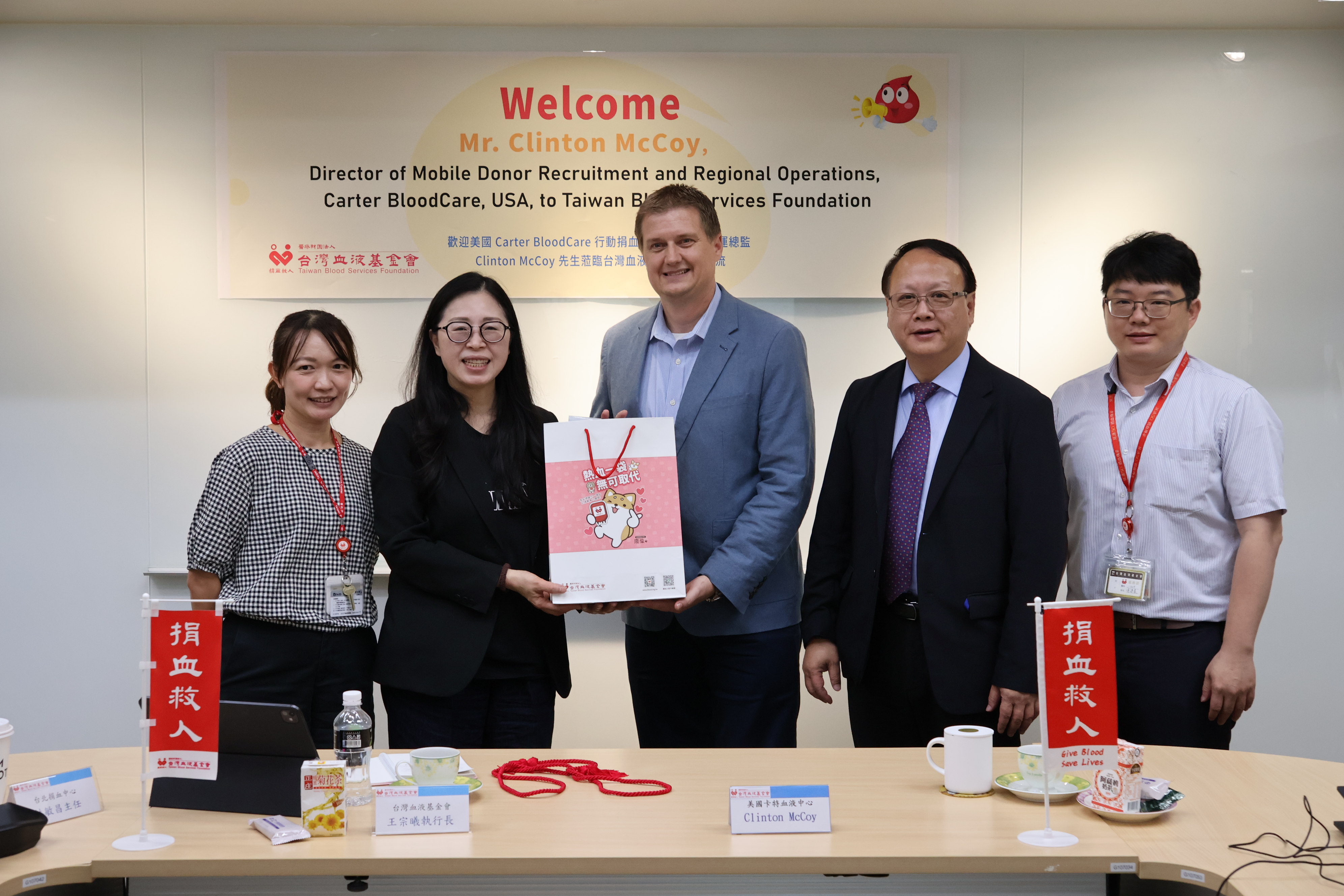
Caption: Clinton McCoy (center), Director of Mobile Donor Recruitment and Regional Operations at Carter BloodCare, visited Taiwan for an exchange with the Taiwan Blood Services Foundation. Foundation CEO Tsung-Hsi Wang (second from left) presented him with a commemorative gift and posed for a group photo with Taipei Blood Center Director Min-Chang Lin (second from right) and others.
Taiwan Blood Services Foundation CEO Tsung-Hsi Wang stated that inviting Director McCoy to speak at the Foundation was a rare and valuable opportunity. The 2026 Annual Conference of the Association for Blood Donor Professionals (ADRP) had just been held from May 12 to 14 this year in Minneapolis, Minnesota, United States. At the time, the Foundation assigned Ko-Han Chao, Chief of the Information Section at Taipei Blood Center, and Chien-Hao Chen, Deputy Chief of the Blood Collection Section, to attend the conference. These two colleagues were the only two Asian speakers at the event and established a connection with McCoy, who also serves as a director of ADRP, thereby creating the opportunity for further exchange between the two sides.
After watching the Taiwan Blood Services Foundation’s introductory video, McCoy introduced himself and explained the current operations of Carter BloodCare. Recognizing that blood centers are in the business of accumulating good deeds, he began working in blood donor recruitment in 2012. In 2019, he became Director of Operations for Carter BloodCare’s East Texas division, and in 2020 he was promoted to his current position, which he has held for six years. He pointed out that during this visit to Taiwan to expand international connections, he learned that Taiwan’s national blood donation rate exceeds 7.7%, while the blood donation rate among people in the United States is below 3%. He said he was very impressed, adding that “we have similarities, because all of our blood is red.”
McCoy noted that Carter BloodCare operates through both fixed blood donation centers and mobile blood drives. In addition to 25 fixed donor rooms, it holds 25 to 30 mobile blood drives every day, amounting to approximately 600 to 700 blood drives each month. What makes him proud is that donors aged 16 to 18 account for 23% of all donors, and compared with other blood centers, Carter BloodCare also has a higher proportion of first-time donors, reaching 31%. The center also frequently organizes blood drives with Rotary clubs, churches, and schools. In particular, it works with approximately 500 nearby schools to hold blood drives. If a school organizes a certain number of blood drives and reaches different goals, the school may receive a grant.
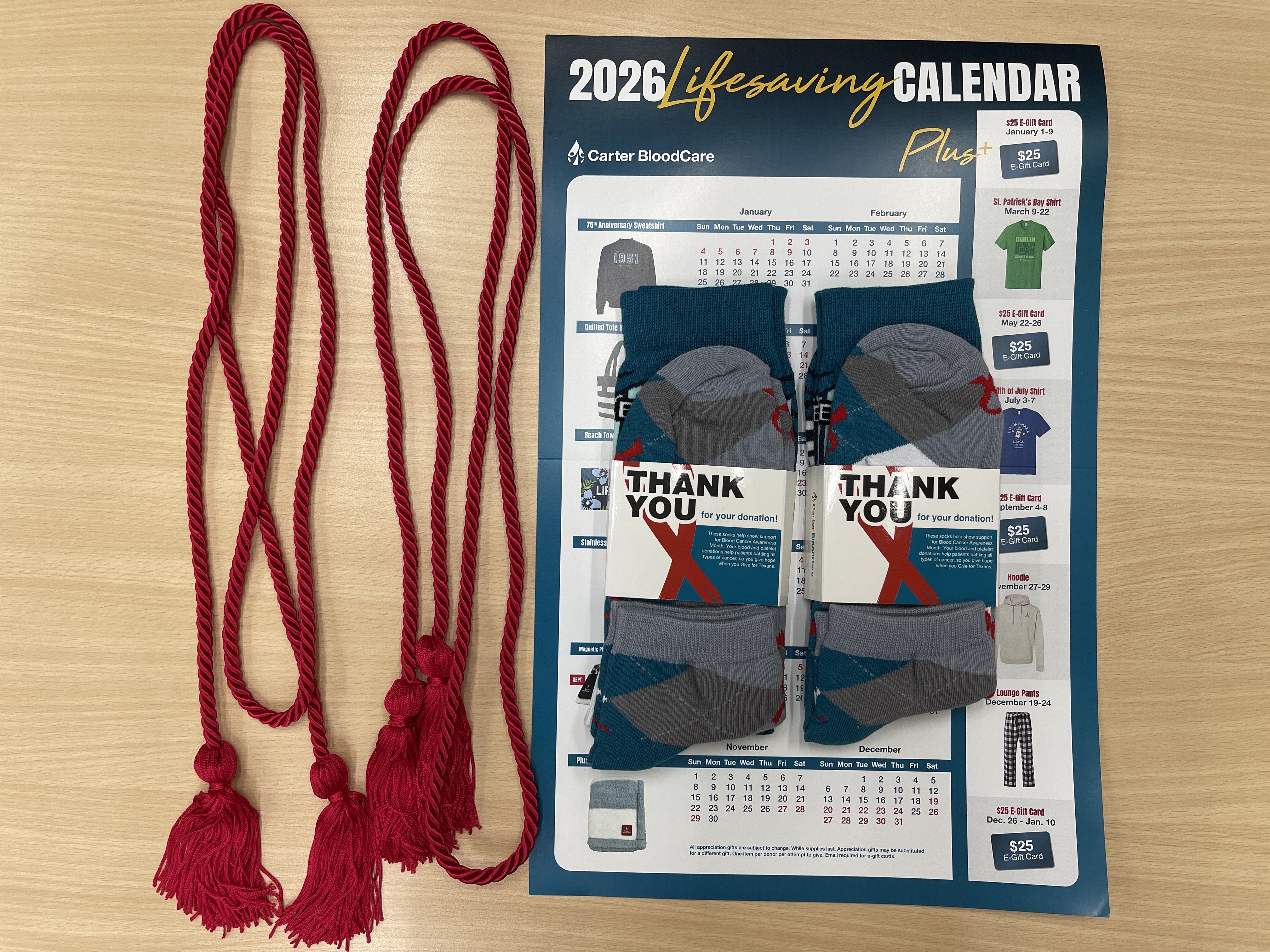
Caption: Promotional materials and donor appreciation gifts produced by Carter BloodCare. The red “Honor Cord” on the left allows high school students who achieve a designated number of blood donations to wear this special honor at their graduation ceremony.
Notably, Carter BloodCare designed a red “Honor Cord” that allows high school students who have donated blood and reached a designated number of donations to wear this symbol of honor over their shoulders at graduation. McCoy said that some students who may not stand out academically can participate in the community as volunteers or become outstanding blood donors. “This gives them a path and an opportunity to serve society,” he said, adding that this carries a great sense of honor in the United States.
However, McCoy also mentioned several challenges faced by Carter BloodCare, including the increasing difficulty of matching rare blood types due to greater racial diversity in the local population, compliance with regulations across different regions, difficulties in staff recruitment and retention, and competition from paid plasma centers. Taking the population structure of the Dallas–Fort Worth Metroplex as an example, he noted that 47% of the population is White, 28% Hispanic, 15% Black, 7% Asian, and 3% other races. In recent years, the increase in the Hispanic immigrant population has created challenges, as sickle cell disease is more prevalent among Hispanic individuals with type O blood. Finding suitable blood donors among the growing minority populations has become their greatest challenge.
Another challenge is that Carter BloodCare promotes voluntary non-remunerated blood donation, while the United States allows privately operated paid plasma centers to exist. McCoy stated that in the United States, a person can receive up to more than US$100 for “selling” one unit of plasma. As a result, many high school students may switch to paid plasma centers after entering college due to financial pressure, and Carter BloodCare may not see them return until after the age of 45. Furthermore, paid plasma centers often offer better salaries, making employee retention more difficult for Carter BloodCare.
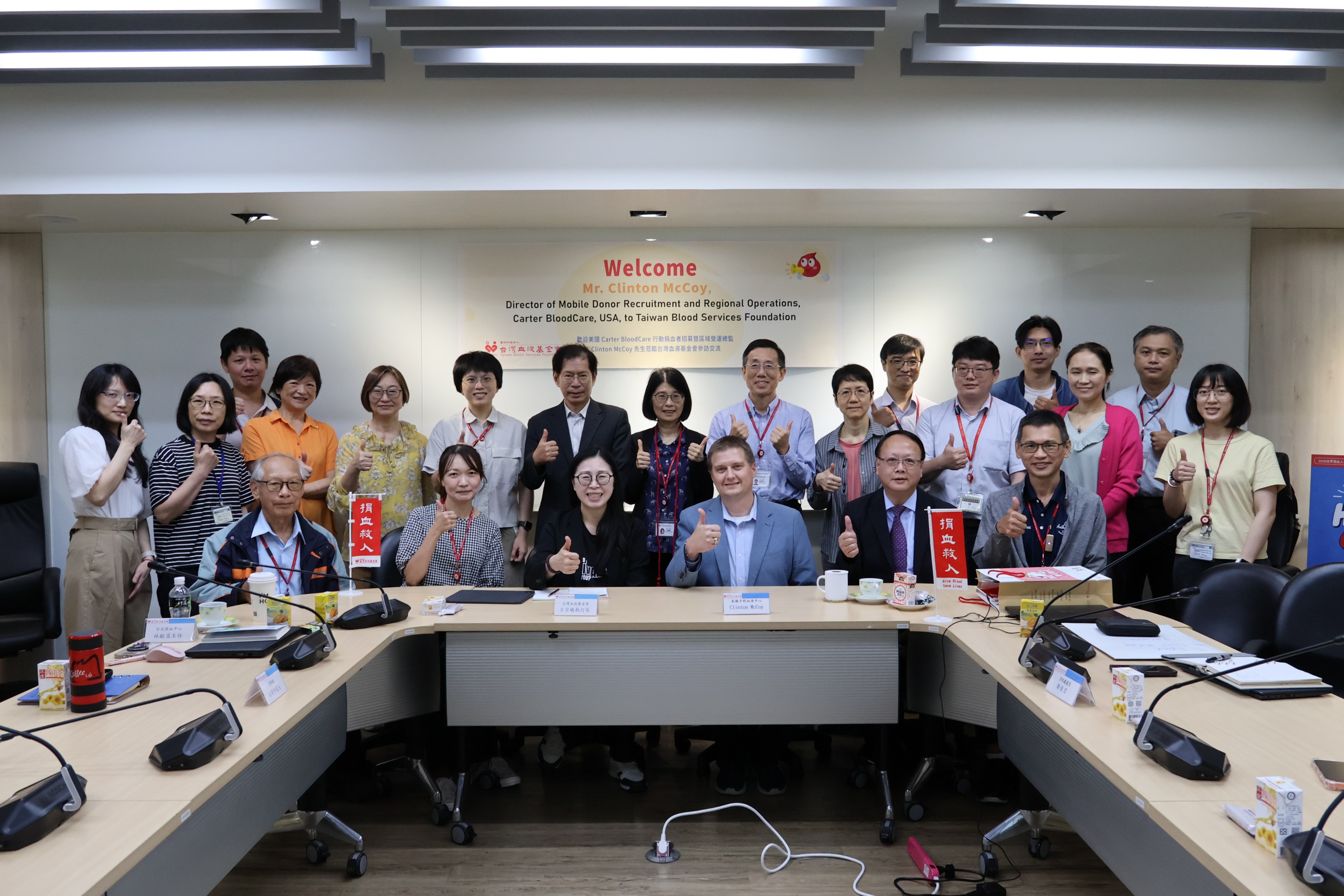
Caption: Carter BloodCare Director Clinton McCoy (seated, third from right in the front row) visited Taiwan to share international experience with the Taiwan Blood Services Foundation on topics including blood collection and supply management. After the session, he took a group photo with Foundation colleagues.
During the exchange session, Taiwan Blood Services Foundation Business Department Director Shun-Chung Pai and Public Relations Department Director Hsuan-Hui Wang each raised questions. They asked about strategies for encouraging donors to move from mobile blood drives—which are often limited by venue, space, and foot traffic—to fixed donation sites, as well as ways to increase the proportion of first-time donors. McCoy said that blood donation should be made as convenient and comfortable as possible for donors, creating a pleasant atmosphere similar to sitting in a Starbucks, and that this fixed-site model can be replicated. As for attracting first-time donors, he believed that more influential blood donation mentors or recruiters should be identified, because relying solely on flyers or emails is not enough to build relationships. Only by finding influential individuals to guide young people into blood donation through face-to-face interaction can better results be achieved. Another approach is to make use of peer influence on campus, such as offering T-shirts at blood drives to encourage young people to wear them and inspire others to follow, or having graduates wear the red “Honor Cord.” Such influence often produces better outcomes.
Taichung Blood Center Director Ying-Sheng Hung asked how much grant funding Carter BloodCare provides to schools and how schools reward students. McCoy said that they encourage schools to hold at least two blood drives per semester. Schools that collect 45 to 75 units of blood can receive a US$500 subsidy; those collecting 75 to 120 units or more can receive US$1,000; and those collecting more than 300 units can receive US$3,000. The grant funds may be used freely by the school, and the center’s overall annual subsidy expenditure exceeds US$180,000. Therefore, he cautioned that although this approach is effective, it must be handled with particular care, “because once it starts, it cannot be stopped.” Over time, the accumulated funding requirement becomes a very large expense.
Taipei Blood Center Director Min-Chang Lin followed up on the previous question by mentioning that in the United States, a pharmaceutical company sponsors the Big Ten Conference to jointly organize a large-scale national blood donation competition for college students and alumni, the We Give Blood drive, with the aim of encouraging college students to donate blood. He asked whether this type of corporate funding support for school-based blood drives would be feasible. McCoy said that corporate sponsorship can be of some help to blood centers to a certain extent. However, he did not express a definite position on whether it would be appropriate to involve companies in blood donor recruitment.
Taiwan Blood Services Foundation CEO Tsung-Hsi Wang stated that, on behalf of Foundation Chairman Sheng-Mou Hou, she warmly welcomed McCoy and thanked him for sharing his professional expertise. She said this was an excellent opportunity for exchange for the Foundation. After all, how to maintain a stable, sufficient, and safe blood supply is an important issue faced by blood organizations around the world. In particular, Taiwan and the United States have much to exchange regarding voluntary non-remunerated blood donation systems, blood quality management, and sustainable operating models. She also noted that Carter BloodCare’s efforts to enhance the sense of honor among high school blood donors and to design warm and welcoming fixed blood donation rooms are highly worthy of reference and learning.
Carter BloodCare is located in the Dallas–Fort Worth Metroplex in Texas, United States. It is a nonprofit, independently operated blood center that collects more than 450,000 units of blood components each year, supplying blood to northern, central, and eastern Texas. Its service area covers the blood needs of more than 225 hospitals across 59 counties.
Caption: Clinton McCoy (center), Director of Mobile Donor Recruitment and Regional Operations at Carter BloodCare, visited Taiwan for an exchange with the Taiwan Blood Services Foundation. Foundation CEO Tsung-Hsi Wang (second from left) presented him with a commemorative gift and posed for a group photo with Taipei Blood Center Director Min-Chang Lin (second from right) and others.
Taiwan Blood Services Foundation CEO Tsung-Hsi Wang stated that inviting Director McCoy to speak at the Foundation was a rare and valuable opportunity. The 2026 Annual Conference of the Association for Blood Donor Professionals (ADRP) had just been held from May 12 to 14 this year in Minneapolis, Minnesota, United States. At the time, the Foundation assigned Ko-Han Chao, Chief of the Information Section at Taipei Blood Center, and Chien-Hao Chen, Deputy Chief of the Blood Collection Section, to attend the conference. These two colleagues were the only two Asian speakers at the event and established a connection with McCoy, who also serves as a director of ADRP, thereby creating the opportunity for further exchange between the two sides.
After watching the Taiwan Blood Services Foundation’s introductory video, McCoy introduced himself and explained the current operations of Carter BloodCare. Recognizing that blood centers are in the business of accumulating good deeds, he began working in blood donor recruitment in 2012. In 2019, he became Director of Operations for Carter BloodCare’s East Texas division, and in 2020 he was promoted to his current position, which he has held for six years. He pointed out that during this visit to Taiwan to expand international connections, he learned that Taiwan’s national blood donation rate exceeds 7.7%, while the blood donation rate among people in the United States is below 3%. He said he was very impressed, adding that “we have similarities, because all of our blood is red.”
McCoy noted that Carter BloodCare operates through both fixed blood donation centers and mobile blood drives. In addition to 25 fixed donor rooms, it holds 25 to 30 mobile blood drives every day, amounting to approximately 600 to 700 blood drives each month. What makes him proud is that donors aged 16 to 18 account for 23% of all donors, and compared with other blood centers, Carter BloodCare also has a higher proportion of first-time donors, reaching 31%. The center also frequently organizes blood drives with Rotary clubs, churches, and schools. In particular, it works with approximately 500 nearby schools to hold blood drives. If a school organizes a certain number of blood drives and reaches different goals, the school may receive a grant.
Caption: Promotional materials and donor appreciation gifts produced by Carter BloodCare. The red “Honor Cord” on the left allows high school students who achieve a designated number of blood donations to wear this special honor at their graduation ceremony.
Notably, Carter BloodCare designed a red “Honor Cord” that allows high school students who have donated blood and reached a designated number of donations to wear this symbol of honor over their shoulders at graduation. McCoy said that some students who may not stand out academically can participate in the community as volunteers or become outstanding blood donors. “This gives them a path and an opportunity to serve society,” he said, adding that this carries a great sense of honor in the United States.
However, McCoy also mentioned several challenges faced by Carter BloodCare, including the increasing difficulty of matching rare blood types due to greater racial diversity in the local population, compliance with regulations across different regions, difficulties in staff recruitment and retention, and competition from paid plasma centers. Taking the population structure of the Dallas–Fort Worth Metroplex as an example, he noted that 47% of the population is White, 28% Hispanic, 15% Black, 7% Asian, and 3% other races. In recent years, the increase in the Hispanic immigrant population has created challenges, as sickle cell disease is more prevalent among Hispanic individuals with type O blood. Finding suitable blood donors among the growing minority populations has become their greatest challenge.
Another challenge is that Carter BloodCare promotes voluntary non-remunerated blood donation, while the United States allows privately operated paid plasma centers to exist. McCoy stated that in the United States, a person can receive up to more than US$100 for “selling” one unit of plasma. As a result, many high school students may switch to paid plasma centers after entering college due to financial pressure, and Carter BloodCare may not see them return until after the age of 45. Furthermore, paid plasma centers often offer better salaries, making employee retention more difficult for Carter BloodCare.
Caption: Carter BloodCare Director Clinton McCoy (seated, third from right in the front row) visited Taiwan to share international experience with the Taiwan Blood Services Foundation on topics including blood collection and supply management. After the session, he took a group photo with Foundation colleagues.
During the exchange session, Taiwan Blood Services Foundation Business Department Director Shun-Chung Pai and Public Relations Department Director Hsuan-Hui Wang each raised questions. They asked about strategies for encouraging donors to move from mobile blood drives—which are often limited by venue, space, and foot traffic—to fixed donation sites, as well as ways to increase the proportion of first-time donors. McCoy said that blood donation should be made as convenient and comfortable as possible for donors, creating a pleasant atmosphere similar to sitting in a Starbucks, and that this fixed-site model can be replicated. As for attracting first-time donors, he believed that more influential blood donation mentors or recruiters should be identified, because relying solely on flyers or emails is not enough to build relationships. Only by finding influential individuals to guide young people into blood donation through face-to-face interaction can better results be achieved. Another approach is to make use of peer influence on campus, such as offering T-shirts at blood drives to encourage young people to wear them and inspire others to follow, or having graduates wear the red “Honor Cord.” Such influence often produces better outcomes.
Taichung Blood Center Director Ying-Sheng Hung asked how much grant funding Carter BloodCare provides to schools and how schools reward students. McCoy said that they encourage schools to hold at least two blood drives per semester. Schools that collect 45 to 75 units of blood can receive a US$500 subsidy; those collecting 75 to 120 units or more can receive US$1,000; and those collecting more than 300 units can receive US$3,000. The grant funds may be used freely by the school, and the center’s overall annual subsidy expenditure exceeds US$180,000. Therefore, he cautioned that although this approach is effective, it must be handled with particular care, “because once it starts, it cannot be stopped.” Over time, the accumulated funding requirement becomes a very large expense.
Taipei Blood Center Director Min-Chang Lin followed up on the previous question by mentioning that in the United States, a pharmaceutical company sponsors the Big Ten Conference to jointly organize a large-scale national blood donation competition for college students and alumni, the We Give Blood drive, with the aim of encouraging college students to donate blood. He asked whether this type of corporate funding support for school-based blood drives would be feasible. McCoy said that corporate sponsorship can be of some help to blood centers to a certain extent. However, he did not express a definite position on whether it would be appropriate to involve companies in blood donor recruitment.
Taiwan Blood Services Foundation CEO Tsung-Hsi Wang stated that, on behalf of Foundation Chairman Sheng-Mou Hou, she warmly welcomed McCoy and thanked him for sharing his professional expertise. She said this was an excellent opportunity for exchange for the Foundation. After all, how to maintain a stable, sufficient, and safe blood supply is an important issue faced by blood organizations around the world. In particular, Taiwan and the United States have much to exchange regarding voluntary non-remunerated blood donation systems, blood quality management, and sustainable operating models. She also noted that Carter BloodCare’s efforts to enhance the sense of honor among high school blood donors and to design warm and welcoming fixed blood donation rooms are highly worthy of reference and learning.
Share on
-
Copied to clipboard
Latest News
2018.03.07