
Articles
2024.02.21
News | Taiwan Blood Services Foundation ESG
Taiwan Blood Services Foundation Sustainable Blood Collection Fleet
Pairing Blood Donation with Low-Carbon Mobility Electric Blood Donation Vehicles Champion Sustainability
Established in 1984 to promote voluntary, non-remunerated blood donation, the Taiwan Blood Services Foundation (TBSF) is Taiwan's sole non-governmental, non-profit charitable institution dedicated to blood collection and supply. Tasked with ensuring the national medical blood supply, TBSF operates four regional blood centers—Taipei, Hsinchu, Taichung, and Kaohsiung—alongside 14 permanent donation stations nationwide.
The year 2022 marked TBSF's Inaugural Sustainability Year, establishing long-term targets for carbon reduction and waste minimization. Regarding decarbonization, stationary blood donation sites have transitioned from conventional diesel generators to grid-supplied electricity, curbing tailpipe emissions, mitigating localized air and environmental pollution, and enhancing the donation experience. Concurrently, TBSF has driven fleet-wide electrification across Taiwan to minimize greenhouse gas emissions.
The deployment of battery electric blood donation vehicles merges public welfare with low-carbon transport, establishing a benchmark for sustainable operations. Delivering zero tailpipe emissions and silent operation, this initiative received the "Taiwan Sustainable Action Award" (TSAA). Through operational donor outreach, environmental education, and ongoing climate advocacy, the public contributes to medical security while actively backing climate solutions—transforming blood donation into an actionable expression of ESG commitment toward Taiwan's 2050 Net-Zero vision.
Sustainable Blood Fleet A Win-Win for Donation and Environment
Over 130 nations—including the United States, Japan, and the European Union—have formally pledged net-zero greenhouse gas emissions by 2050. In lockstep with this global energy transition, TBSF has proactively addressed fleet emission challenges. By partnering with corporations and civic groups, TBSF advances blood collection alongside shared sustainability goals through an eco-friendly mobile fleet.
The green fleet incorporates Battery Electric Vehicles (BEVs) and Hybrid Electric Vehicles (HEVs). Fully electric donation vehicles operate completely free of gasoline or diesel, deploying for collection duties once fully charged. Each vehicle features two independent electrical architectures: an EV traction powertrain and an auxiliary system powering onboard climate control, illumination, and diagnostic laboratory devices during stationary donation operations. Hybrid electric donation vehicles are powered by internal combustion engines during transit; upon arrival at the stationary collection point, they connect directly to external shore power to support air conditioning, lighting, cold-chain blood product storage, and clinical collection equipment. After the session concludes, the vehicle unplugs and returns to the center using its engine.
TBSF currently operates 8 battery electric donation vehicles, 7 hybrid electric donation vehicles, and 14 stationary donor trailers—all of which rely on dedicated external grid hookups or towable power connections without idling emissions.
High acquisition costs pose significant capital fundraising hurdles for large-scale electric medical vehicles. TBSF extends its deepest gratitude to our donor partners for their dedication to public health and green stewardship.
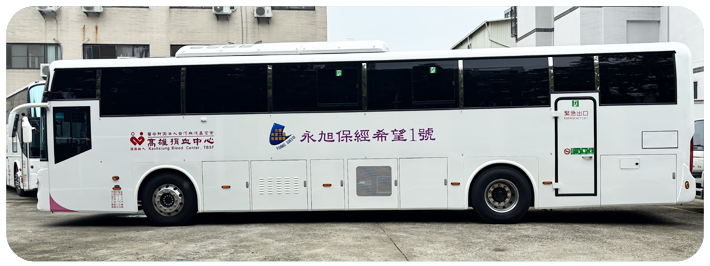
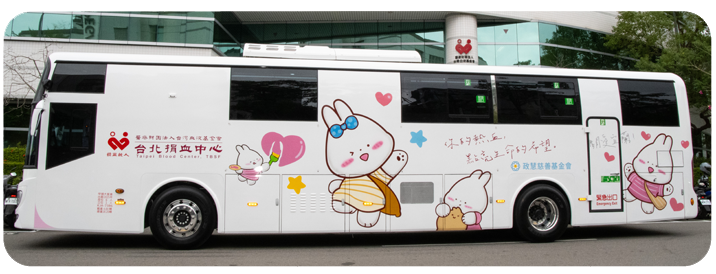
The operational performance of the 8 active electric blood donation vehicles is outlined below: (Notes: 1. Grid Electricity Emission Factor: 0.509 kg CO2e/kWh; 2. Diesel Emission Factor: 2.646 kg CO2e/L; 3. Diesel Fuel Consumption Rate: 0.9 L/km)
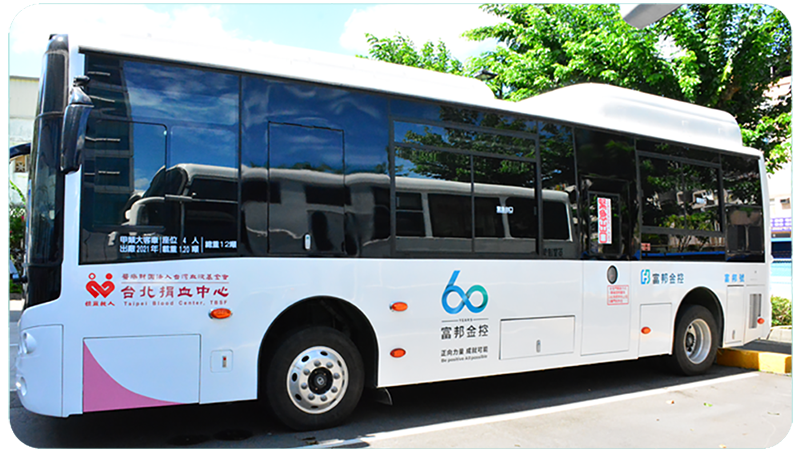
1 🔋 Fubon
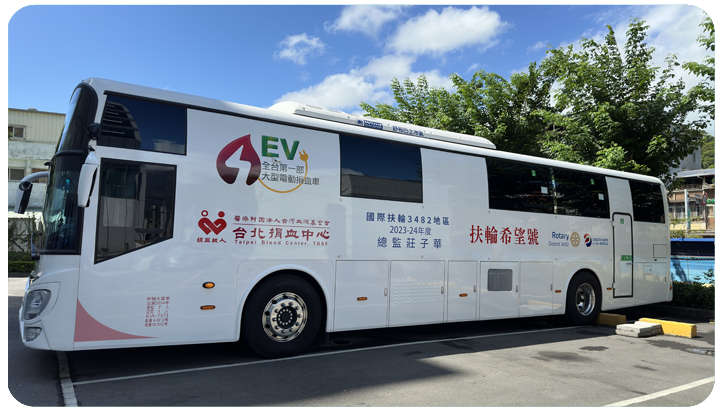
2 🔋 Rotary Hope
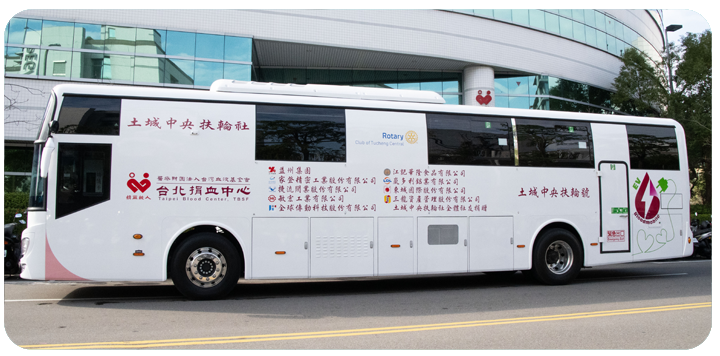
3 🔋 Tucheng Central Rotary
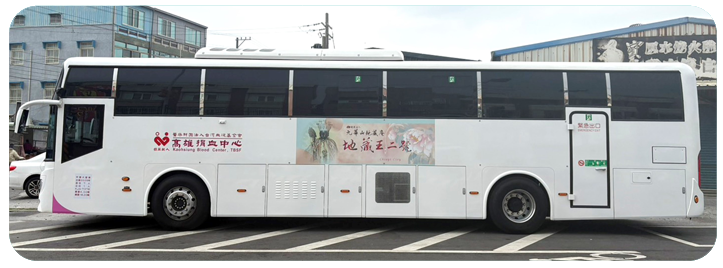
4 🔋 Ksitigarbha II
5 🔋 Ever Sun Insurance Hope No. 1
6 🔋 Zheng Hui No. 1
7 🔋 Zheng Hui No. 2
8 🔋 Jingfu
Advancing Green Healthcare Transformation: Operational Impacts and Climate Action of Electric Blood Donation Buses
Taipei Blood Center has actively spearheaded fleet electrification. Following the commissioning of Taiwan's premier heavy-duty all-electric blood donation bus "Rotary Hope," the center partnered with National Taiwan University of Science and Technology (Taiwan Tech) on a comparative empirical study titled "Comparative Analysis of the Implementation Benefits of Electric Blood Donation Vehicles in Taiwan." Utilizing real-world telemetry monitoring alongside Life Cycle Assessment (LCA) methodologies, this initiative translates sustainability vision into verifiable data.
Data-Driven Sustainability Validation: Comparative Fleet Trial
The project applied a rigorous "paired dispatch, side-by-side" experimental framework at high-footfall collection sites, including Taiwan Tech and Vieshow Cinemas Xinyi, dispatching the battery electric bus (Rotary Hope) alongside an equivalent diesel bus (St. Ignatius Plaza) under identical duty cycles. Findings demonstrate marked operational efficiencies and ecological advantages for the electric bus:
- Superior Decarbonization Performance: Field measurements verify that greenhouse gas emissions from electric blood donation buses decreased by an average of 45% to 50.6% compared to conventional diesel vehicles. Over a single deployment, diesel bus emissions averaged 106.86 kg-CO2e, whereas the electric bus generated just 53.06 kg-CO2e, significantly lowering the operational carbon footprint of clinical collection.
- Elevated Energy Conversion Efficiency: Electric drivetrains achieved an energy efficiency of 80% to 90%, substantially exceeding the 20% to 30% thermal efficiency typical of diesel combustion engines. In donation service profiles characterized by extended stationary dwell times and frequent start-stops, electric buses eliminate idling exhaust emissions and fuel burn, embodying the core values of energy conservation and carbon reduction.
- Acoustic and Community Benefits: External noise monitoring during operation showed acoustic levels significantly lower than those of diesel buses, fostering a tranquil and welcoming clinical environment for donors and neighboring communities while elevating public recognition of green healthcare initiatives.
Economic Viability and Long-Term Operational Resilience
Beyond environmental benefits, the project integrated a Total Cost of Ownership (TCO) asset evaluation model to redefine long-term asset value. While the procurement capital expenditure for a heavy electric blood donation vehicle stands at roughly NT$13 million—higher than the NT$6 million typical of diesel buses—its long-term operational cost advantages remain substantial. By pairing charging schedules with Taipower's three-tier time-of-use (TOU) electricity tariffs, each electric vehicle is projected to save approximately NT$111,000 annually in fuel and energy overhead.
Share on
-
Copied to clipboard
Articles
2024.02.20