
Latest News
2026.04.17
News | Taiwan Blood Services Foundation ESG
- News
- Latest News
- Building a Low-Carbon Blood Product Supply Chain to Create a Vision of Green and Sustainable Healthcare
Back to List
Building a Low-Carbon Blood Product Supply Chain to Create a Vision of Green and Sustainable Healthcare
Latest News
2026.10.27
As the world faces the shared challenges of climate change and the transition toward net-zero emissions, how healthcare systems can reduce their environmental impact while safeguarding patient health has become an important issue in sustainable healthcare development. Yun-Lung Wang, Director of Hsinchu Blood Center, pointed out that from the collection of blood from a donor’s arm to testing, processing, storage, transportation, and final delivery to hospitals for patient use, blood goes through a complete and complex supply chain. Therefore, the Taiwan Blood Services Foundation is actively promoting green healthcare by addressing every stage of the process to establish a low-carbon blood supply system that balances patient safety, blood product quality, and environmental sustainability.
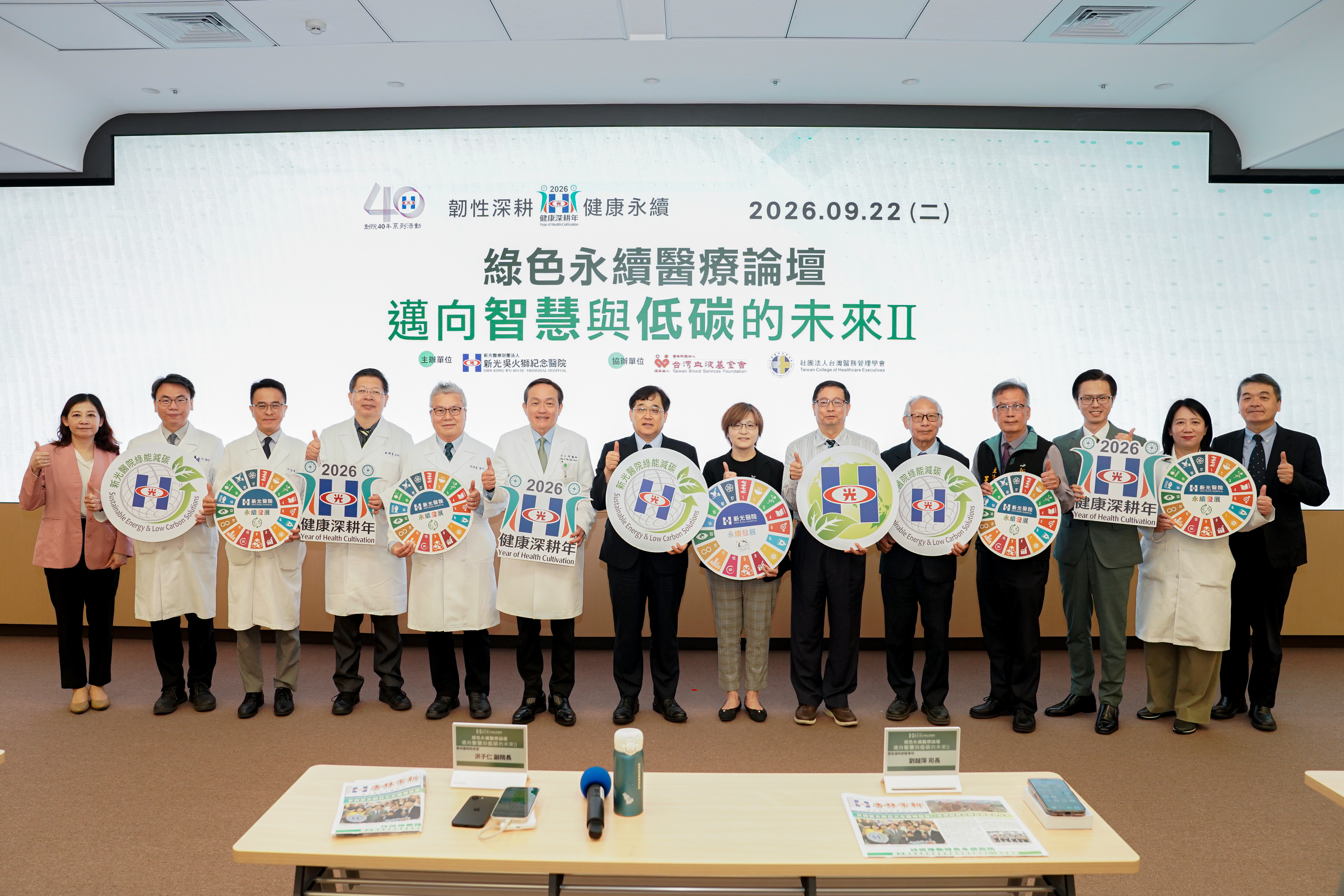
Caption: At the “Green and Sustainable Healthcare Forum: Towards a Smart and Low-Carbon Future II,” hosted by Shin Kong Hospital, Yueh-Ping Liu, Director-General of the Department of Medical Affairs, Ministry of Health and Welfare (seventh from right), attended the event and joined representatives of the organizing and co-organizing institutions and speakers for a group photo.
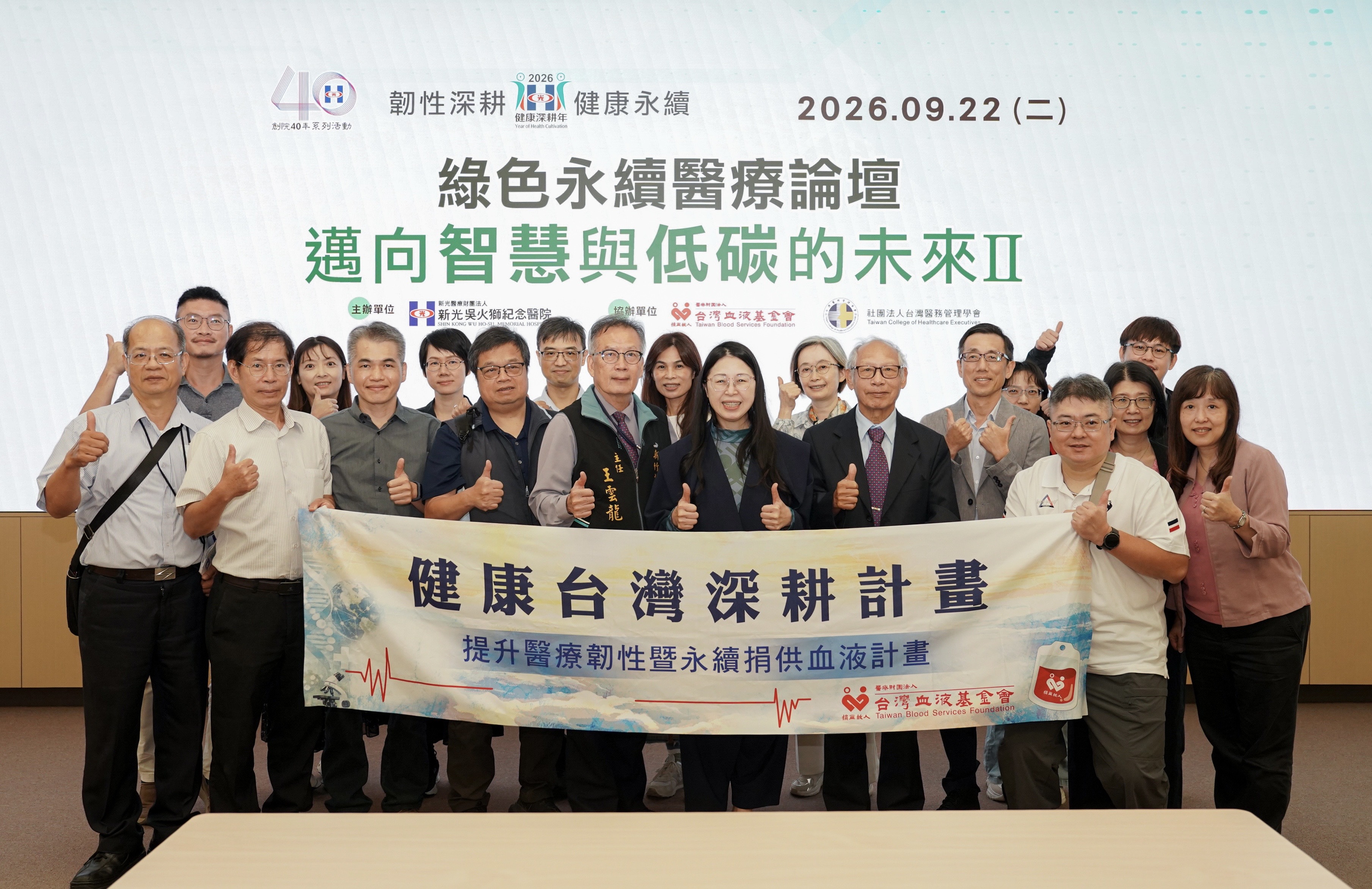
Caption: The Taiwan Blood Services Foundation co-organized the “Green and Sustainable Healthcare Forum: Towards a Smart and Low-Carbon Future II.” A group photo of all participants was taken after the forum.
Taiwan Blood Services Foundation Co-organizes Green and Sustainable Healthcare Forum
The “Green and Sustainable Healthcare Forum: Towards a Smart and Low-Carbon Future II,” hosted by Shin Kong Wu Ho-Su Memorial Hospital and co-organized by the Taiwan Blood Services Foundation and the Taiwan College of Healthcare Executives, was held on September 22 at the Friendship Building of Shin Kong Hospital. Sheng-Mou Hou, President of Shin Kong Hospital and Chairperson of the Taiwan Blood Services Foundation, was unable to attend due to other official commitments but delivered an encouraging message through a prerecorded video. He stated that, in response to climate change and the global trend toward net-zero emissions, healthcare systems must not only safeguard public health but also reduce carbon emissions and promote sustainable development. The forum therefore invited experts from the medical, financial, and healthcare sectors to share their experiences and insights on topics ranging from low-carbon supply chains and green finance to carbon footprints and low-carbon practices in clinical settings. Through cross-disciplinary exchanges, the forum aimed to ensure that “sustainability is not merely a concept, but something truly implemented in every aspect of healthcare operations.”
Tzu-Jen Hung, Vice President of Shin Kong Hospital, also stated that, in response to Taiwan’s goal of achieving net-zero emissions by 2050, healthcare institutions must adopt smart technologies and digital tools to adequately address future challenges. Accordingly, the forum focused on concrete examples of best practices, including smart carbon footprint tracking in Shin Kong Hospital’s dialysis unit, paperless operations and environmentally friendly practices at its health examination center, and the Nutrition Department’s efforts to reduce carbon emissions through creative plant-based cuisine.
Yueh-Ping Liu, Director-General of the Department of Medical Affairs, Ministry of Health and Welfare, commended Shin Kong Hospital for being a pioneer in promoting green and sustainable healthcare. She noted that Taiwan’s medical community has already begun advancing green and sustainable healthcare, but the core concept of “sustainability” lies in how to allocate existing resources as efficiently as possible. Moreover, individual efforts alone are insufficient; external partners must also be brought into the process. She welcomed the participation of the Taiwan Blood Services Foundation and E.SUN Bank in sharing their experiences at the forum, particularly regarding the promotion of a “low-carbon blood product supply chain” and how financial institutions can provide green momentum for hospital transformation. These efforts will help build a low-carbon healthcare ecosystem capable of both safeguarding lives and protecting the environment.
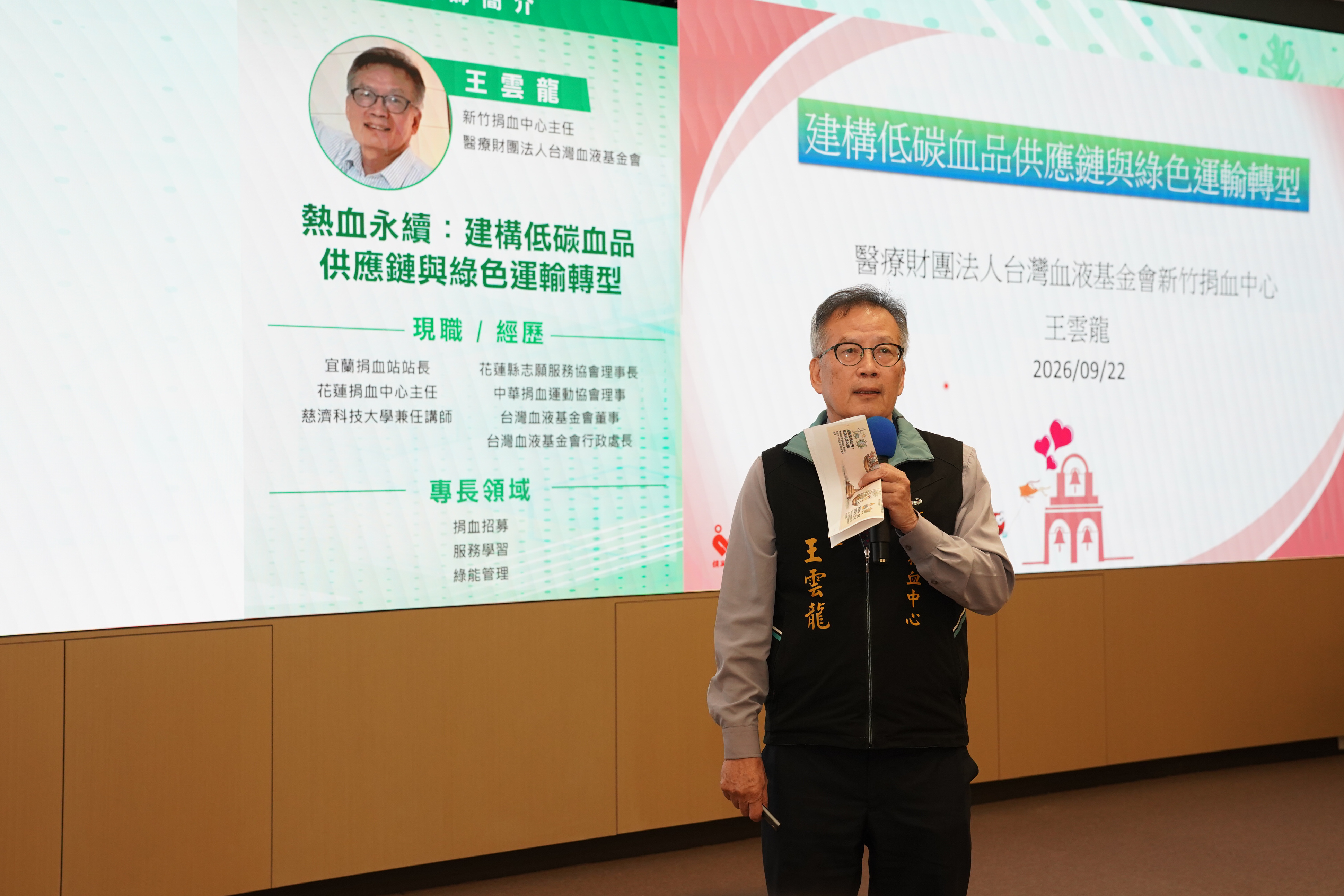
Caption: Yun-Lung Wang, Director of Hsinchu Blood Center, delivered a presentation titled “Sustainable Blood Services: Building a Low-Carbon Blood Product Supply Chain and Green Transportation,” explaining the Taiwan Blood Services Foundation’s active efforts to establish a green supply chain for blood used in medical care.
During the forum, Yun-Lung Wang, Director of Hsinchu Blood Center, delivered a presentation titled “Sustainable Blood Services: Building a Low-Carbon Blood Product Supply Chain and Green Transportation.” He explained that a green supply chain for blood used in medical care is not simply about reducing carbon emissions. Rather, it involves managing the entire process in a more environmentally friendly and efficient manner while ensuring patient safety and blood product quality. The Foundation is actively working toward these goals through measures such as improving the energy efficiency of blood cold-chain logistics, optimizing transportation routes to reduce carbon emissions, introducing demand forecasting to prevent waste caused by expired blood products and reduce unnecessary blood collection, and implementing Patient Blood Management (PBM) to minimize unnecessary transfusions.
In terms of green transportation, the Foundation has gradually explored the possibility of transitioning the energy sources used by its bloodmobile fleet. Wang pointed out that diesel-powered bloodmobiles produce exhaust emissions during both driving and blood donation operations, as well as noise and vibration. Therefore, the Foundation has actively introduced environmentally friendly bloodmobiles in recent years. This transition not only helps reduce carbon emissions during blood donation services but also symbolizes the implementation of green transformation in blood services, beginning at the blood collection stage.
In addition, the Foundation has incorporated sustainability into its daily operations by promoting waste reduction at the source, green procurement, environmental greening and beautification, and green office practices, gradually integrating environmental sustainability into blood service workflows. Wang cited resource consumption data from the Caring Building of Hsinchu Blood Center over the past three years as an example, noting that paper consumption has declined year by year, while electricity consumption also decreased significantly in 2025.
Drone Blood Delivery: Creating Green Healthcare Logistics
In addition to promoting low-carbon transformation through energy management, transportation, and manufacturing processes, the Taiwan Blood Services Foundation continues to explore how emerging technologies can improve blood supply efficiency and healthcare resilience. Wang explained that Hsinchu Blood Center conducted Taiwan’s first emergency blood delivery project using drones last year. The project simulated blood transportation from Hsinchu Blood Center to Army Hospital 813 and successfully completed six simulated test flights. Strict temperature control ensured blood quality and safety, while the five-kilometer flight took only 10 minutes. This approach can overcome geographical and traffic barriers, achieving significantly greater efficiency than conventional vehicle transportation. Furthermore, the drones are electrically powered, with plans to incorporate hydrogen fuel cells, paving the way for zero-carbon-emission green healthcare logistics.
Wang emphasized that green healthcare is not an unattainable slogan, but something that can be put into practice through everyday work. From reducing carbon emissions from bloodmobiles and implementing green procurement to promoting energy recycling in blood component manufacturing and appropriate blood utilization in clinical settings, each individual change may seem small, but together they can generate a powerful force driving healthcare sustainability.
Caption: At the “Green and Sustainable Healthcare Forum: Towards a Smart and Low-Carbon Future II,” hosted by Shin Kong Hospital, Yueh-Ping Liu, Director-General of the Department of Medical Affairs, Ministry of Health and Welfare (seventh from right), attended the event and joined representatives of the organizing and co-organizing institutions and speakers for a group photo.
Share on
-
Copied to clipboard
Latest News
2025.05.26