
Awards
2024.11.15
News | Taiwan Blood Services Foundation ESG
- News
- Awards
- The Association Honored with the "Humanities Enterprise Award" for Exemplary Social Care; Secretary-General Wang Tsung-hsi: "Blood donation is Taiwan's most beautiful scenery."
Back to List
The Association Honored with the "Humanities Enterprise Award" for Exemplary Social Care; Secretary-General Wang Tsung-hsi: "Blood donation is Taiwan's most beautiful scenery."
Awards
2026.05.20
The Chinese Voluntary Blood Donation Association has been promoting voluntary, unpaid blood donation for over half a century. Today (24th), it was honored with the 3rd "Humanities Enterprise Award" for Exemplary Social Care, with the Association's Secretary-General, Wang Tsung-hsi, representing the organization to accept the award. During the afternoon sharing session, she expressed her gratitude for the selfless dedication of all blood donors, noting that "blood donation has become a cycle of love that benefits both others and oneself." She dedicated the honor of the award to the public, expressing her hope that blood donation becomes not just a public welfare activity, but an integral part of the culture and the most beautiful scenery in Taiwanese society.
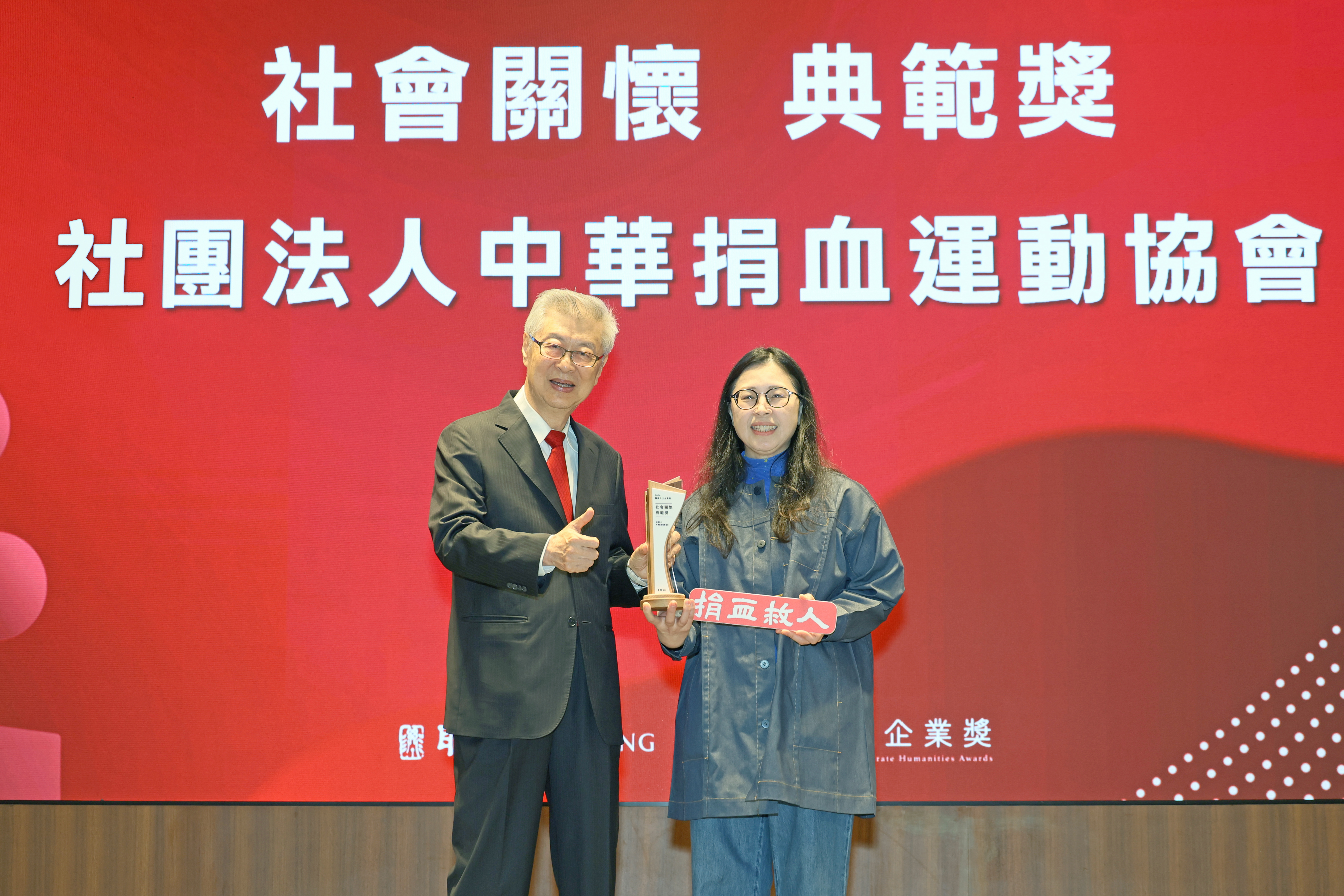
The Association was honored with the 3rd "Humanities Enterprise Award" for Exemplary Social Care. Secretary-General Wang Tsung-hsi (right) accepted the award on behalf of the organization and took a photo with the presenter, Chen Chung (left), Chairman of the Vision Project Foundation. Photo credit: Linking Publishing Company
The "Humanities Enterprise Award," organized by Linking Publishing Company, entered its third year this year. The award ceremony was held at the Chiang Ching-kuo Presidential Library in Taipei City. A total of 38 enterprises and organizations received awards, drawing over a hundred representatives from industry, government, and academia to witness this heartwarming and inspiring event. The "Humanities Enterprise Award" features five main categories: Social Care, Ecological Conservation, Regional Development, Educational Advancement, and Arts and Culture Promotion. These are further categorized into the Exemplary Award, Excellence Award, and Outstanding Award. The Exemplary Award is the most prestigious and difficult to attain, representing deep cultivation and outstanding contributions to the field over many years.
The award ceremony opened with speeches by Lin Tsai-chueh, Publisher of Linking Publishing Company, and Chen Chung, Chairman of the Vision Project Foundation, who also served as the convener of the judging panel. Lin Tsai-chueh first paid tribute to all the award-winning enterprises and organizations. Regarding the hosting of the "Humanities Enterprise Award," he broken down the Chinese character for enterprise, "企" (Qi), explaining that it is composed of "人" (person) and "止" (stop). He observed that "with people, an enterprise moves forward; without people, it stops," asserting that humanities should become part of an enterprise's DNA and be internalized as a vital element. Chen Chung also noted that while corporate social responsibility was initially described as maximizing profits, it has transformed in recent years into ESG (Environmental, Social, and Governance). He called for corporate entities to act more like natural individuals, incorporating more human touch and humanitarian concern to achieve sustainable development.
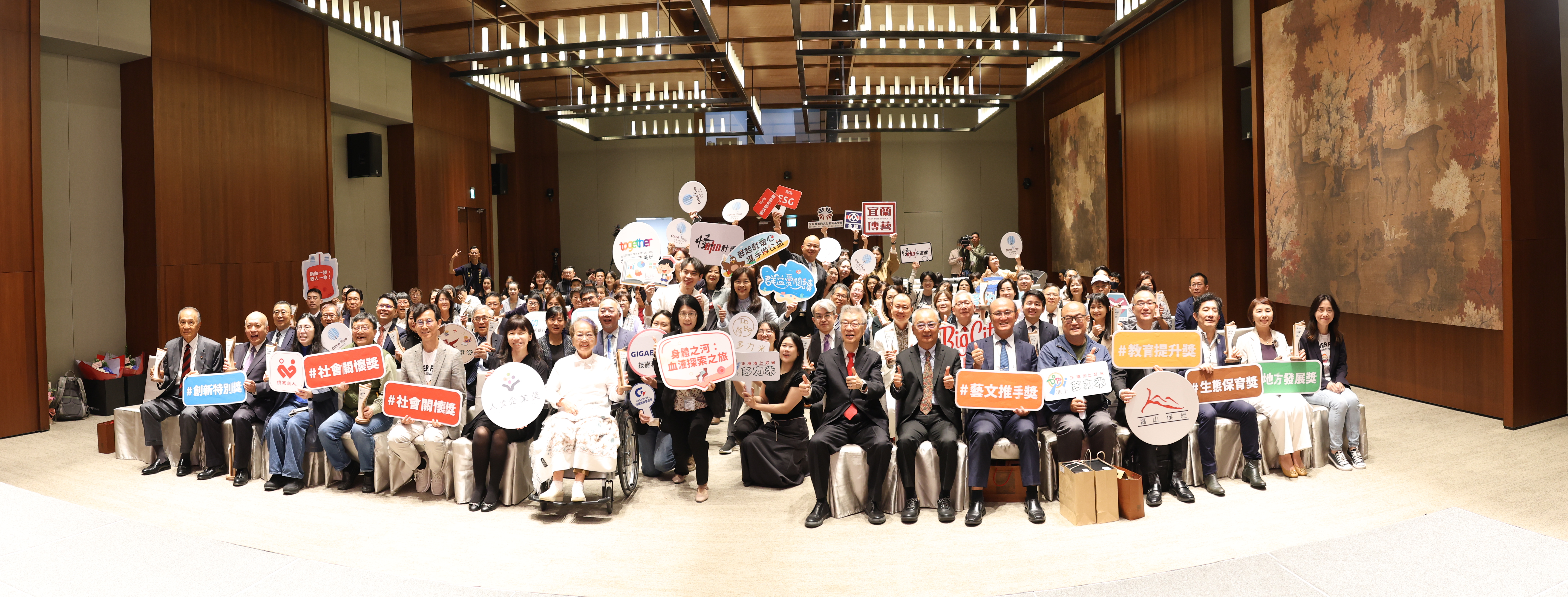
At the 3rd "Humanities Enterprise Award" ceremony, the presenters from the organizing body pose for a group photo with representatives from all award-winning enterprises and organizations.
During the sharing session following the ceremony, Secretary-General Wang Tsung-hsi was invited to deliver a speech titled "50 Years of Surging Passion: The Cycle of Love and Life." She pointed out that before the 1970s, when citizens in Taiwan needed blood transfusions, a small portion of blood was mobilized from medical staff or patients' relatives, but most relied on professional blood sellers, commonly known as "blood bulls," as the primary source. However, the quality and safety of such blood were deeply concerning. Consequently, the Chinese Voluntary Blood Donation Association was established in 1974 to actively promote the concept of donating blood to save lives. Moving from paid blood donations to establishing a voluntary, unpaid donation system, Taiwan went on to set a world-record citizen donation rate of 8.13%, making blood donation Taiwan's most successful social movement.
Over the years, the Chinese Voluntary Blood Donation Association has actively established blood testing and quality management systems, including pre-donation screening and post-donation testing. In 2013, Nucleic Acid Testing (NAT) was fully introduced for Hepatitis B, Hepatitis C, and HIV, significantly shortening the window period and elevating blood transfusion safety to the highest international standards. Additionally, the association has implemented the "domestic blood for domestic use" policy, promoting domestic blood products to secure a self-sufficient healthcare defensive line.
Wang emphasized that in recent years, the Chinese Voluntary Blood Donation Association has aligned with the "Healthy Taiwan" vision to strengthen the resilience of blood supply and demand, creating a resilient and inclusive healthcare model. The association won the 2025 Presidential Hackathon Distinguished Team Award for its "In-Hospital Blood Inventory × Passionate Flight" project. It has also established a real-time blood collection and inventory monitoring system, combining technology with smart efficiency to ensure that every drop of blood reaches where it is needed most at the most critical moment.
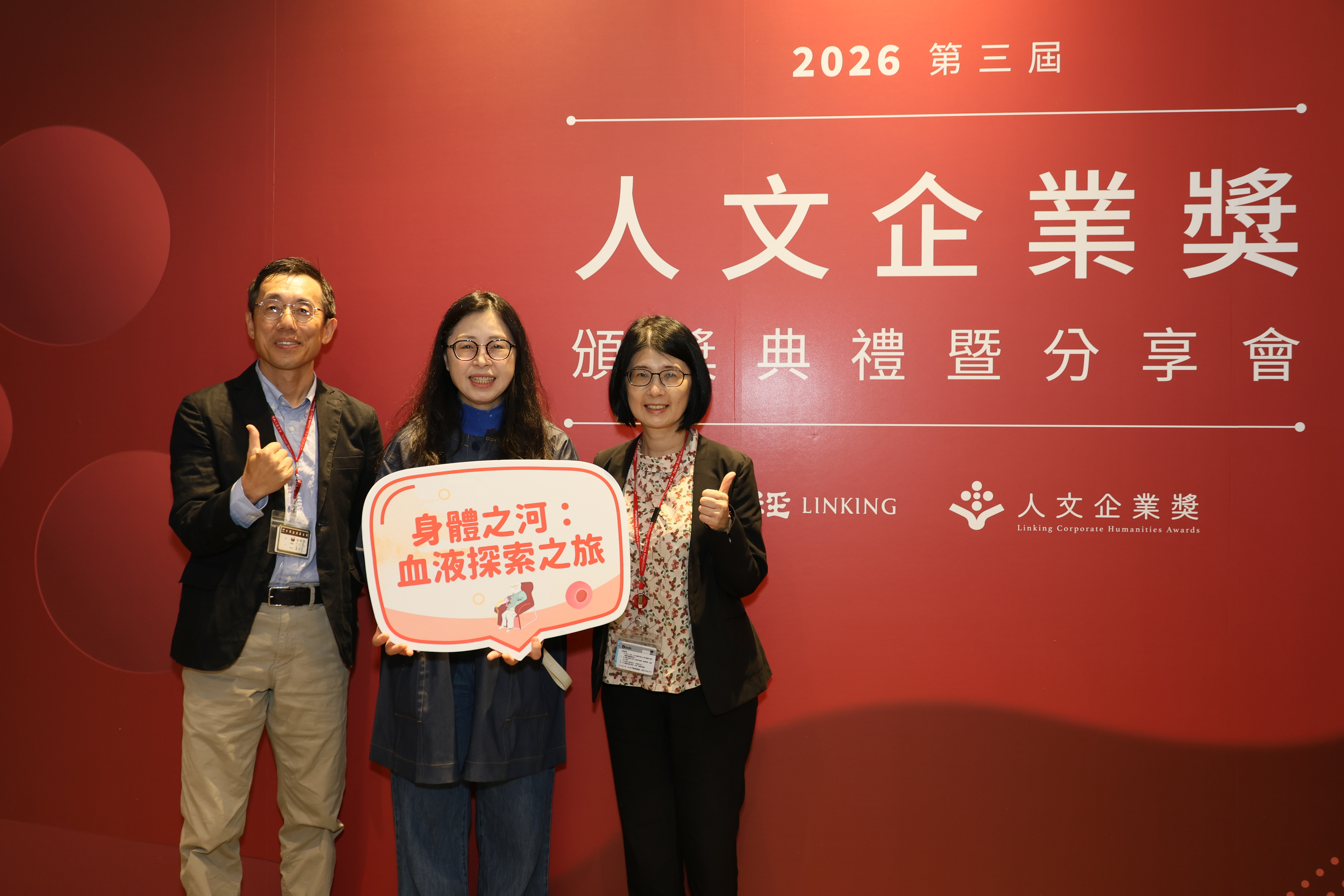
Association Secretary-General Wang Tsung-hsi (center), Public Relations Section Chief Wang Xuan-hui (right), and Administrative Section Chief Huang Yao-tsung (left) pose together in front of the backdrop at the "Humanities Enterprise Award" ceremony.
Faced with the impact of Taiwan's aging population and declining birth rates, changes to the demographic structure of blood donors are inevitable. Secretary-General Wang stated that because the youth demographic and first-time donors are decreasing annually, while the long-term regular donor group is gradually aging, the association must innovate new humanities-based strategies to address the challenges of the new generation. To root these concepts early, projects like the 2023 "Blood Lessons for Young Adults" and the 2025 "River of the Body: A Journey of Blood Exploration" have turned blood donation concepts into life education. Furthermore, the association advocates for middle-aged individuals to become the backbone of blood supply resilience, encouraging adults aged 40 to 60 to actively participate in blood donation.
Share on
-
Copied to clipboard
Awards
2023.08.18